



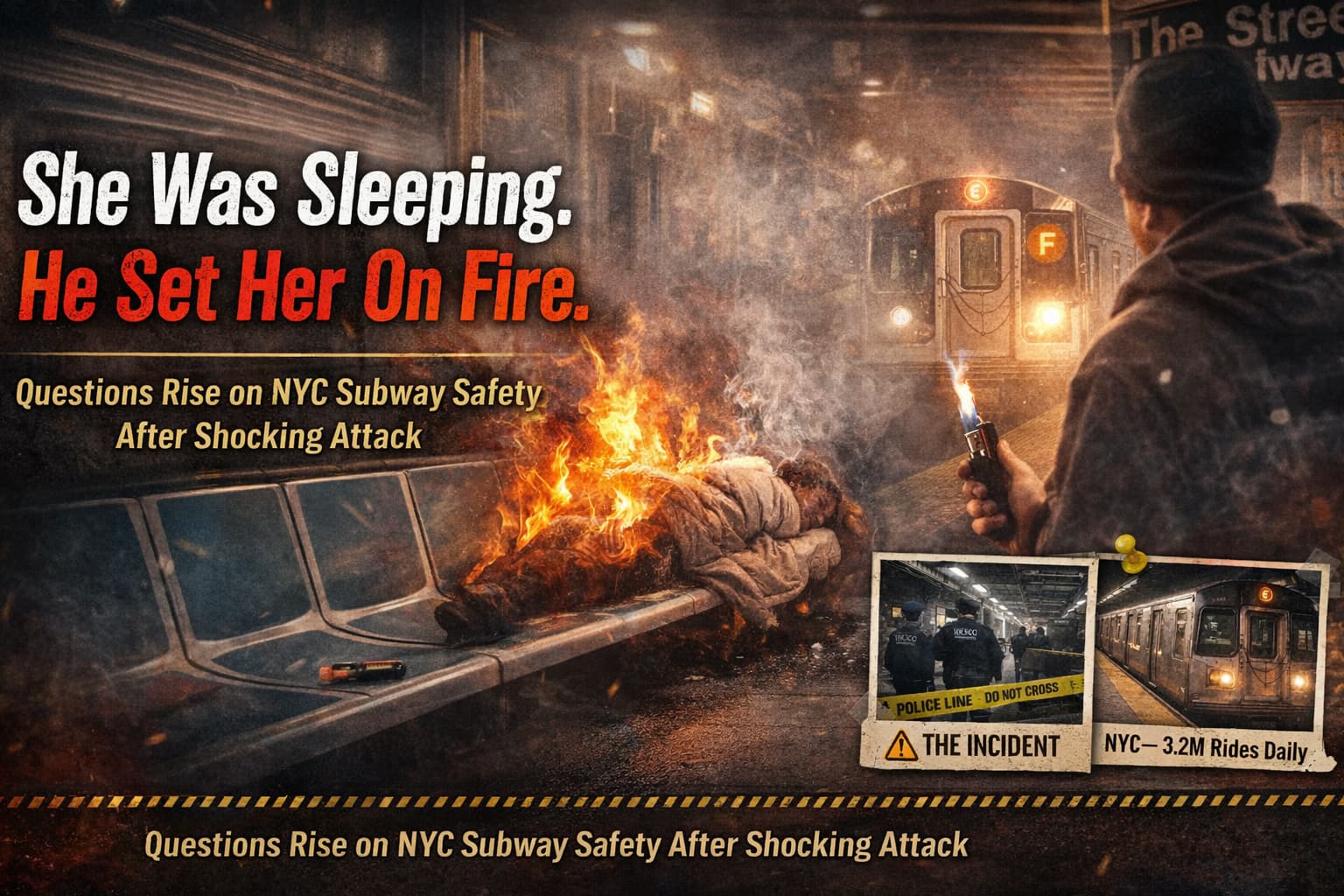
She Was Sleeping He Set Her on Fire.
By Penny Montague | February 07, 2026 | Share on
A woman, aged 57, was killed on a New York City subway train in December. This event caused national concern. Questions were raised regarding the methods used to provide protection against unpredictable violence.
⚠ THE INCIDENT
On December 22, 2024, at approximately 7:30 AM, Debrina Kawam, a 57-year-old woman from Toms River, New Jersey, was sleeping on a stationary F train at the Coney Island Stillwell Avenue station in Brooklyn. Sebastian Zapeta-Calil, 33, approached her calmly and used a lighter to ignite her clothing and the blanket wrapped around her. He then fanned the flames with his shirt before stepping off the train.
Zapeta sat on a nearby platform bench and watched as she burned. Officers on an upper level noticed the smell and sight of smoke and went to investigate. An MTA worker used a fire extinguisher to put out the flames, but Kawam was pronounced dead at the scene at 7:48 AM. The medical examiner determined that she died from thermal injuries and smoke inhalation.
Zapeta was arrested several hours later at Herald Square after three high school students recognized him on another subway train and called 911. He was indicted on first- and second degree murder and arson charges.
Source: NYPD, Brooklyn District Attorney’s Office, CNN, NBC News
The murder of Debrina Kawam is one of the most disturbing crimes in recent New York City history, not because of its complexity, but because of its total absence of it. There was no dispute. No confrontation. No provocation of any kind. A man simply walked up to a sleeping woman on public transit and murdered her in one of the most painful ways imaginable. He then stayed to watch.
NEW YORK CITY SUBWAY SYSTEM CARRIES APPROXIMATELY 3.2 MILLION RIDERS (ABOUT THE POPULATION
OF ARKANSAS) DAILY – THE LARGEST TRANSIT NETWORK IN THE U.S.
Kawam grew up in Little Falls, New Jersey, where friends remembered her as a popular student and cheerleader. In her 20s she traveled with friends to Jamaica, Mexico, the Bahamas, and Las Vegas. She worked at Merck, the pharmaceutical giant, from 2000 to 2002. At some point, her life took a
difficult turn. By late 2024, she had briefly stayed in a New York City homeless shelter. On the morning of December 22, temperatures were around 20°F — below freezing for 24 hours — and she was sleeping on the subway for warmth.
“Someone nearby noticed what was happening and had the tools to step in before anyone got hurt.”
Thousands of miles away, Jamaica Star recently reported growing fear among women who no longer feel safe doing basic things like commuting home after work or waiting for transportation at night. Many shared stories of harassment, close calls, and moments where they realized how vulnerable they were.
“PEOPLE SHOULD NOT BE LIVING ON OUR SUBWAY SYSTEM. THEY SHOULD BE IN A PLACE OF CARE.”
– NYC MAYOR ERIC ADAMS
- Dec 22, 2024 — ~7:25 AM:
Debrina Kawam is sleeping on a stationary F train at Coney Island–Stillwell Avenue. Temperatures are below freezing outside. Sebastian Zapeta-Calil approaches her. - Dec 22, 2024 — ~7:30 AM
Zapeta uses a lighter to ignite Kawam’s clothing and blanket. He fans the flames with his shirt. Her clothing becomes fully engulfed in seconds. He exits the train and sits on a platform bench, watching. - Dec 22, 2024 — 7:48 AM
Officers on an upper-level smell smoke and investigate. An MTA worker extinguishes the fire. Kawam is pronounced dead at the scene. - Dec 22, 2024 — Hours later
Three high school students recognize Zapeta on another subway train from circulated body-camera images. They call 911. He is arrested at Herald Square with a lighter in his pocket. - Dec 31, 2024
Nine days after the attack, the victim is finally identified as Debrina Kawam, 57, via fingerprints — her body was too badly burned for other identification methods. - Jan 2025
A memorial service is held at First Baptist Church of Sheepshead Bay. Zapeta is indicted on four counts of murder and one count of arson. The top charge carries life without parole. - 10
Murders on NYC subways in 2024 — tying the highest since at least 2006 - 65%
Increase in subway felony assaults from 2019 to 2024 - 3.2M
Daily subway riders in NYC — the largest transit system in the U.S.
The subway system in New York City is ranked as a safe network. Over 750,000 rides were provided for every major felony in 2024. A crime decreases of 5.4% was noted compared to 2023. Life is ended by single acts of violence. Comfort is not provided by data when these events occur.
According to research from Vital City, NYC, the nature of subway crime has fundamentally shifted since 2009. Felony assaults have more than tripled. Robberies have declined, but impulsive, unprovoked attacks have surged. The shift is away from crimes driven by greed and toward violence driven by animus or chaos, random pushes, slashings, and attacks with no discernible motive. This is the category of crime that is hardest to predict and nearly impossible to deter through policing alone. Murders on the subway in 2022 and 2024 tied for the highest count since at least 2006, even as overall crime trended downward.
The Kawam case raised questions about homelessness, mental health, and public transit. It was reported to police by Zapeta that alcohol was consumed and events were not remembered. Connections to the city shelter system were held by both individuals. Both people were considered vulnerable. The subway was used as a place for warmth because temperatures were below freezing.
INDIVIDUAL SAFETY AND PREPAREDNESS
Personal preparedness is formed by awareness, tools, and habits. This creates a safety layer that systems cannot replace. Specific tools mentioned for this purpose include:
Protection against random or instant acts of violence is not guaranteed by any tool or level of awareness. This is illustrated by the case of Debrina Kawam, who was attacked while asleep. The event occurred in seconds. However, the odds of survival are increased by personal preparedness when danger is seen. In these moments, the use of proper tools is considered effective.
Pepper Spray – Your First Line
Compact enough to clip to a keychain or slip into any coat pocket. Modern formulations use precision nozzles to minimize blowback in tight spaces like subway cars. Effective, affordable ($15–$35), and legal in most U.S. states. Some models include a wrist strap for secure grip.
Safety Apps & GPS Sharing
Apps like bSafe, or built-in iPhone/Android emergency SOS features, can silently alert trusted contacts with your real-time location in a single button press. Some offer voice-activated alerts or automatic check in systems that trigger an alarm if you don’t respond within a set timeframe.
Tactical Flashlight
A high-lumen tactical flashlight (500+ lumens) illuminates poorly lit stations and tunnels, and can temporarily blind or disorient an attacker at close range. Many models feature a serrated bezel that doubles as a striking surface. Cost: $20–$50.
Personal Alarm
At 130 decibels – louder than a jet engine at 100 feet – a personal alarm shatters any attacker’s concentration and immediately draws every bystander’s attention. Many models activate with a pin-pull mechanism: fast, instinctive, no fumbling required. Cost: $10–$20.
Situational Awareness Training
The most powerful self-defense tool is your mind. Knowing how to scan your environment, recognizing behavioral warning signs, and avoiding high-risk windows – late night rides, end-of-line stations, empty cars – reduces your exposure before any physical confrontation begins. Many cities now offer free or low-cost workshops.
The Kawam case showed that all transit users are at risk. The belief that public spaces stay safe proved wrong. This event took place on a Sunday morning in a crowded city. Police were located nearby during the time of the attack.
Non-lethal self-defense is not seen as fear. Preparation is chosen as a way to face reality. A safety layer is built when tools are joined with training and habits. This layer is not offered by city or transit systems. Safety was deserved by Debrina Kawam and is deserved by every person. While systems are fixed, preparation is used to fill gaps.
This story is the first in an ongoing series, each one grounded in real events, verified data, and practical safety lessons. Non-lethal self-defense isn’t a radical idea — it’s a practical one. Stay informed. Stay prepared.