

Blog
For many people, daily routines are supposed to feel normal. Walking to the car after work. Waiting for a bus. Running a quick errand in the evening. But in cities like Portland, Oregon, those ordinary moments don’t always feel predictable anymore.
Recent news stories across the U.S. and internationally show a shared reality: when danger appears suddenly, most people aren’t prepared to respond. Not because they don’t care, but because they never thought they’d need to.
When Real Life Turns Unpredictable
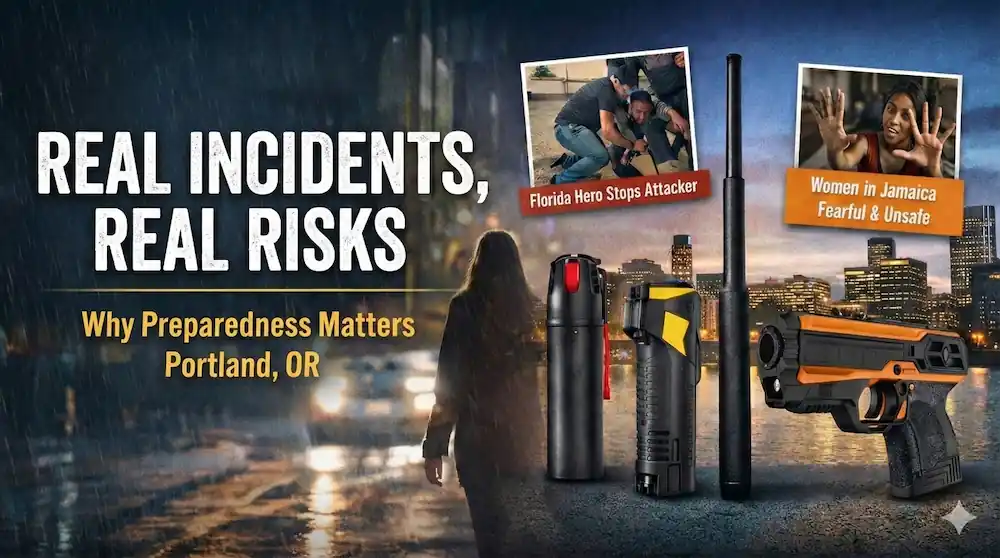
A recent incident in Florida made national headlines when a Good Samaritan stopped a knifewielding attacker who had just been released from jail. The situation got out of hand quickly, leaving no warning and No time to “think it through.”
“Someone nearby noticed what was happening and had the tools to step in before anyone got hurt.”
Thousands of miles away, Jamaica Star recently reported growing fear among women who no longer feel safe doing basic things like commuting home after work or waiting for transportation at night. Many shared stories of harassment, close calls, and moments where they realized how vulnerable they were.
“Different countries. Different laws. Same problem.”
People are realizing that feeling safe and being prepared are not the same thing.
Why Awareness Alone Isn’t Always Enough
Experts agree that awareness is the first layer of self-defense. Paying attention to surroundings. Not being distracted. Trusting your instincts.
“But awareness only buys time.”
A kickboxing instructor quoted in the Jamaica report explained that attackers are often physically stronger, and without tools, victims are at a clear disadvantage. Even trained individuals are taught that self-defense is not about winning a fight, it’s about creating an opportunity to escape safely.
That reality matters in Portland, where unpredictable encounters are becoming more common in public spaces, parking lots, and transit areas.
Parents worry about their kids.
Commuters worry about timing their walks home.
Moms and dads worry about being able to protect themselves without causing permanent harm.
The Gap Between Fear and Preparedness
Many people adapt their routines instead of addressing the risk.
They leave earlier.
Avoid certain areas.
Stay constantly alert.
But those changes don’t build confidence. They create tension.
Preparedness is different. It’s about knowing you have options, non-lethal options, if something
goes wrong.
And in Oregon, unlike some other parts of the world, legal non-lethal self-defense tools are
available.
Why Non-Lethal Self-Defense Matters
Non-lethal self-defense tools are not about aggression. They are about distance, control, and escape.
In high-stress situations, tools like:
- Pepper spray in Portland
- Stun guns and taser guns in Portland
- Batons
- Byrna non-lethal launchers
can give ordinary people the ability to respond without escalating a situation to deadly force. This matters deeply to parents and everyday citizens who don’t want lethal weapons, but also don’t want to feel helpless.
A non-lethal option can
- Create space between you and a threat
- Interrupt an attack long enough to escape
- Reduce the chance of serious injury or death
- Provide confidence without encouraging confrontation
“This balance is why more and more Portland residents are rethinking their approach to staying safe”
Lessons From Places Without Option
The Jamaica Star article revealed a hard truth, many women feel unsafe because most selfdefense tools, like pepper spray and tasers, are restricted.
Experts openly acknowledged that without tools, people are at a disadvantage.
Portland residents can get non-lethal self-defense products, but the responsibility has shifted. Will we be ready before trouble strikes, or only discuss safety once it’s too late?
This Isn’t About Living in Fear
Preparedness is not panic.
It’s not paranoia.
And it’s not about assuming the worst.
It’s about accepting reality.
Portland is full of life, but it faces challenges just like any big city. Ignoring them won’t help. Responsible preparation is what keeps people safe.
Non-lethal tools don’t replace awareness or training. They add an extra layer of protection, just like seatbelts. They don’t replace careful driving, but they do save lives.
What Preparedness Looks Like for Real People
Preparedness means:
- Understanding your surroundings
- Learning basic self-defense principles
- Knowing which non-lethal tools are legal and appropriate
- Choosing tools that fit your comfort level
- Practicing decision-making before stress hits
For moms and dads, it means knowing they have a way to protect themselves without risking permanent harm to others.
For students and commuters, it means confidence instead of constant anxiety.
For communities, it means fewer tragedies, and fewer “what if” conversations after the fact.
The Takeaway
Real stories from Florida and Jamaica show us something important:
Danger doesn’t announce itself.
Preparation can’t wait until later.
Non-lethal self-defense isn’t about fear, it’s about readiness.
In cities like Portland, unpredictable situations are a reality. Having access to non-lethal selfdefense tools and knowing how and when to use them can make a real difference.
Not because people want trouble.
But because they want to get home safely
Inspired by Real Events
This article was inspired by real incidents and public safety discussions reported by trusted news sources, highlighting the importance of preparedness and non-lethal self-defense options in everyday life.
Sources:
- A Good Samaritan in Florida Stopped a Knife-Wielding Attacker – DeSantis Daily
https://www.desantisdaily.com/a-good-samaritan-in-florida-stopped-a-knife-wieldingmaniac-that-prosecutors-had-released-from-jail-just-eight-days-earlier/ - Strike, Kick, Punch – Women Urged to Learn Self-Defence – Jamaica Star
https://jamaica-star.com/article/news/20260113/strike-kick-punch-women-urged-learnself-defence